Despite the growing demand for water, sanitation and hygiene (Wash), allocations to local councils for delivery of such services have reduced in real terms with money going to the Water Resources Fund not increasing in five years.
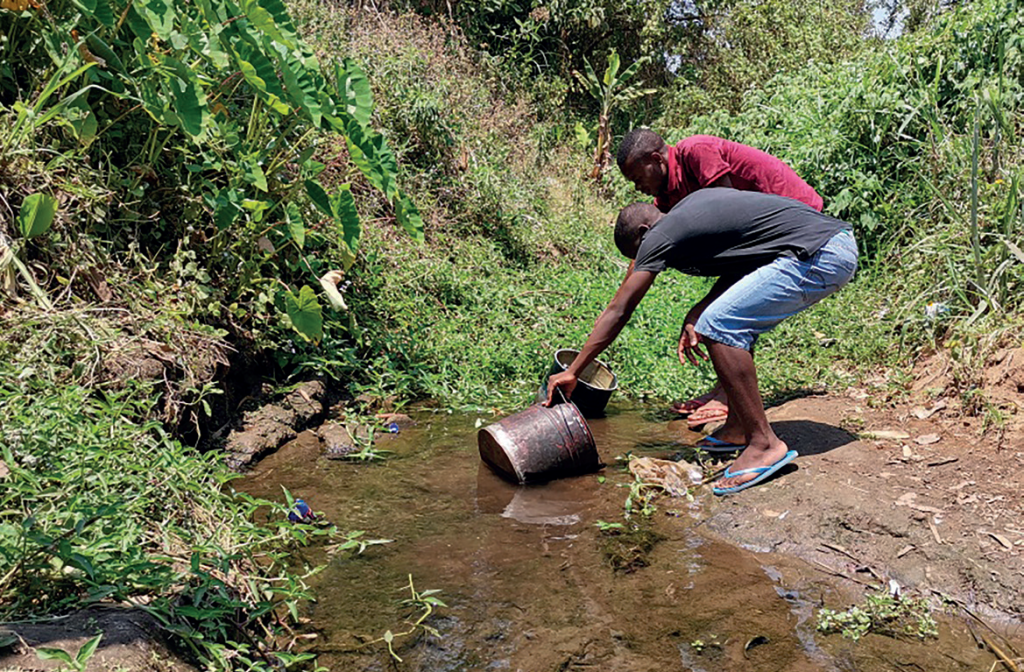
Meanwhile, water experts have decried the development, arguing that it poses serious health risks as in the long-run communities will be forced to draw water from contaminated sources.
They also say at any given point no less than 30 percent of water points are non-functional, and 24 percent of healthcare facilities have dysfunctional water systems.
Since the 2021/22 financial year, central government transfers to the councils have stagnated at around K2.3 billion annually or lower, despite national budgets increasing by over 300 percent from about K2 trillion to the current K8.08 trillion during the same period.
Trends in the composition of Wash sector budgets reveal that during the financial years 2021/22, 2023/24, 2024/25 and the current 2025/26 allocations to the councils have remained at K2.316 billion, with the exception of 2022/23 when it was reduced to K1.737 billion.
a health hazard. I Nation
In real terms, allocations to the fund have cumulatively reduced by over half, compared to 2021/22 when one US dollar was equivalent to around K744 while the same one US dollar is now trading at around K2 751. The K2.3 billion annual allocation translates into K12 million per constituency per year.
The past three financial years show education, health and agriculture sectors are the largest in terms of transfers to the local councils.
Each member of Parliament (MP) gets K12 million alongside the Constituency Development Fund (CDF), to improve water access and management.
The MPs manage CDF, currently pegged at K200 million, together with the Water Resources Fund under the same guidelines known as CDFWRF (Constituency Development Fund Water Resources Fund).
The WRF was established by the Water Resources Act of 2013 that establishes a fund to finance water resource conservation and management through drilling and maintenance of water infrastructure.
Water and Environmental Sanitation Network (Wesnet) acting executive director Hopeson Chaima observed the stagnation of Water Fund had serious negative impact on the water sector as, among others, it will lead to non-maintenance of the water infrastructure.
“In the long-run, there will be so many non-functional boreholes or water points and most communities will end up getting water from contaminated sources… The drilling of new water points and other things will also be greatly affected,” said Chaima.
He also observed that with inflation and continued escalation of commodity prices, the K12 million annual allocation per constituency is no longer adequate to invest in the water sector.
On his part, WaterAid Malawi head of policy and communication Chandiwira Chisi said any reduction to financial allocations and flow to the districts was unfortunate and certainly risks reversing gains made.
“With limited funds, it’s not possible for technical teams at the district council to conduct routine water tests, support water management systems, let alone support maintenance.
“Our biggest threat is lack of investment in maintenance and it begins with simple things like officers being mobile enough to monitor performance of the systems,” he said.
Chisi said at any given point, no less than 30 percent of water points are non-functional and 24 percent of health care facilities have dysfunctional water systems.
“What we need at this point is a significant increase in resource allocation and flow to the districts. With high inflation, it is obvious that the cost of delivering water services, for instance, is high.
“This can be seen in the rise of tariffs by water utilities over the last couple of years. This is meant to sustain water services to their customers. Unfortunately, major reach out for water utilities is in urban and semi-urban areas. This leaves out the rural communities to NGOs that are often project driven and the district councils that are heavily underfunded. We are almost leaving the rural communities to themselves,” he said.
But for Centre for Social Accountability and Transparency (Csat) executive director Willy Kambwandira observed that the situation reflects more than just budgetary constraints.
He said: “This is an illustration of structural reluctance from the central government to meaningfully empower the local councils to deliver on their mandates and functions..”
Kambwandira, whose organisation is involved in budget tracking, said the reality was that central government continues to retain much funding and decision-making power.
“The allocation is nominal especially in the context of the current kwacha devaluation and inflation… The revelations confirm that councils have seen devolution of responsibilities but not the funding,” he said.
Former Parliamentary Committee on Natural Resources and Climate Change chairperson Werani Chilenga confessed that allocations have stagnated but attributed the development to issues of prioritisation.
He said: “For several years that has been the biggest challenge. Governments from previous regimes have been prioritising other sectors such as education, health and agriculture.”
The Water Fund is a government initiative established by Parliament, which determines the overall funding allocation.
Treasury administers the fund by channelling resources through the Local Government Finance Committee. This committee then disburses the funds to district councils.
According to Unicef’s 2025/26 Wash Budget Brief, the resources are increasingly insufficient, especially considering growing demand for Wash services due to population growth and recurring health and climate-related emergencies, and will likely adversely impact the delivery and functionality of local water and sanitation services.
However, Unicef observes that despite the drive towards decentralisation, Wash sector allocations remain overwhelmingly centrally managed under the Ministry of Water and Sanitation (MoWS).
“About 99 per cent [K282.1 billion] of Wash allocations in 2025/26 are centrally allocated under the MoWS. Only 1 per cent of the budget is decentralised to local councils through the Water Fund [K2.3 billion] and transfers for Other Recurrent Transactions [ORT] [K426 million] – yet majority of Wash services are delivered at local level,” reads the brief.